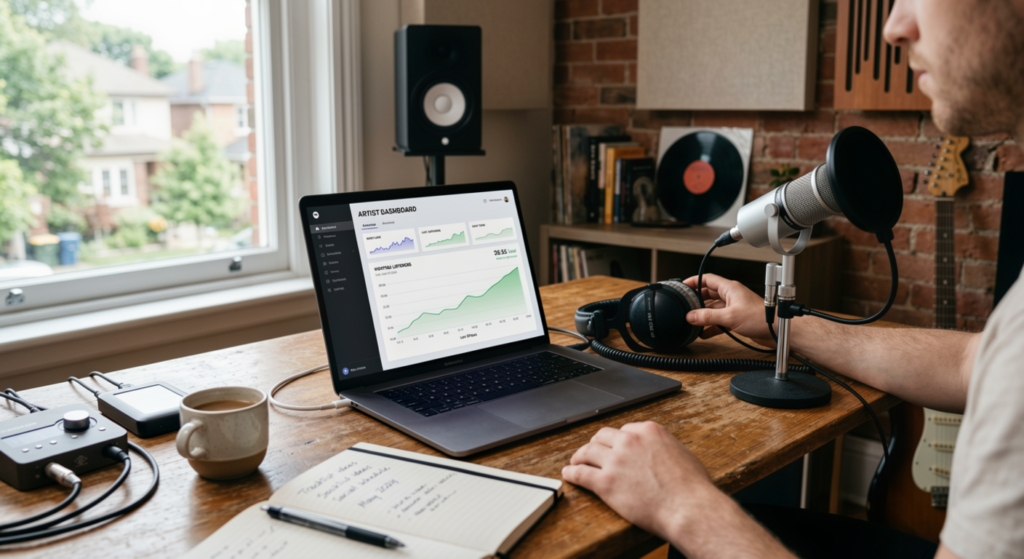
Buy Spotify monthly listeners means paying a third-party service to boost the listener count shown on your Spotify artist profile. These services often sell packages promising a set number of monthly listeners.
The problem is that you cannot simply purchase genuine fans in the same way you purchase an advertisement. Real listeners decide whether they like a song, save it, follow an artist, add it to a playlist, or come back for another release. A package that promises a fixed audience number does not necessarily create that kind of engagement.
Some services may use questionable playlist networks, automated activity, incentivized listening, or other methods designed to generate streams without genuine listening intent. Spotify classifies activity that does not reflect genuine user listening intent as artificial streaming.
Can You Legally Buy Spotify Monthly Listeners?
The important distinction is between buying music promotion and buying guaranteed Spotify activity.
Paying for advertising or legitimate promotion that introduces your music to potential listeners is fundamentally different from paying a service that promises a certain number of Spotify streams or listeners. Spotify specifically states that paid third-party services guaranteeing streams or playlist placement are not legitimate.
So, if a company says, “Pay $50 and we guarantee 10,000 Spotify listeners,” that should immediately raise a red flag. The guarantee itself is a warning sign because genuine audience behavior cannot be reliably purchased as a fixed number.
A safer approach is to spend your promotional budget on reaching people who might genuinely enjoy your genre, sound, or particular release.
Why Do Artists Want More Monthly Listeners?
There is an understandable reason artists search for this service. Monthly listeners are one of the most visible numbers on a Spotify artist profile, so a growing figure can make an artist appear to have more reach.
For an independent artist, that number can also be useful as one piece of social proof when someone discovers a new song. A person may see that an artist has an established audience and become curious enough to listen.
But monthly listeners should not be treated as the complete picture of an artist’s audience. Spotify provides additional audience segments because different listeners interact with music in very different ways.
An artist with fewer monthly listeners but a strong group of returning fans can have a very different audience relationship from an artist whose listeners mostly arrive once and never return.
How Spotify Monthly Listeners Actually Work
Spotify’s monthly listener figure is based on listeners within a rolling 28-day period rather than a fixed calendar month. This means the number can rise and fall naturally as different people discover, revisit, or stop listening to an artist.
For example, imagine an artist releases a new single and 3,000 new people listen during the following weeks. The monthly listener number may climb quickly. As those listeners fall outside the 28-day window, the number can later decline if new listeners are not replacing them.
This is normal audience behavior, not necessarily a sign that something has gone wrong.
Spotify’s newer audience reporting also separates monthly listeners from monthly active listeners. Monthly active listeners are people who intentionally streamed music through active sources during the previous 28 days, while programmed listeners can come from sources such as personalized playlists and other programmed listening.
What Happens When You Buy Artificial Listeners?
The biggest problem is that artificial activity can be removed.
Spotify says confirmed artificial streams do not earn royalties, do not count toward public stream numbers or charts, and do not positively influence recommendation algorithms. Depending on the severity, additional consequences can include playlist removal and action by the artist’s distributor.
That means paying for a large number does not guarantee that the number will remain on your profile.
Spotify also says it performs ongoing cleaning to remove confirmed artificial streaming from public metrics. As a result, an artist may see a sudden change after suspicious activity is identified.
Can Buying Listeners Get Your Music Removed?
In serious cases, yes.
Spotify states that artificial streaming can lead to actions beyond removing streams. Depending on the circumstances, a distributor may issue a warning, charge a penalty fee, suspend an account, or remove music from Spotify. Spotify also says tracks can be removed in cases where artificial streaming is particularly severe.
This is why the cheapest-looking promotion can become expensive. You could pay for a service, lose the artificial activity later, and potentially create problems with your distributor at the same time.
For an artist building a catalog over several years, protecting the account and release history is generally more important than creating a temporary spike.
How to Spot a Suspicious Spotify Promotion Service
One of the easiest warning signs is a guaranteed result.
Be cautious if a website promises an exact number of Spotify streams, monthly listeners, followers, or guaranteed playlist placement for a fixed payment. Spotify specifically warns artists about services making these kinds of promises.
Another warning sign is a service that refuses to explain how listeners discover the music. A legitimate marketing campaign should be able to explain what audience is being targeted, where the promotion appears, and what the artist is actually paying for.
You should also be skeptical of dramatic promises such as overnight growth, guaranteed algorithmic promotion, guaranteed editorial playlists, or a promise that Spotify will automatically recommend your song after a certain number of purchased streams.
Spotify states that services claiming they can guarantee algorithmic recommendations or paid playlist placement are not legitimate.
Is Spotify Playlist Promotion the Same as Buying Listeners?
No. Playlist promotion can cover very different activities, so the details matter.
If you pay for advertising that introduces your song to potential fans, you are paying for exposure. The people reached by that promotion can decide whether they want to listen.
A service that instead promises a specific number of Spotify streams or listeners is a different proposition. Spotify explicitly prohibits paid third-party services that guarantee streams or playlist placement.
The safest question to ask before paying is simple: Am I paying to reach potential fans, or am I paying someone to manufacture Spotify activity?
That question can save an independent artist a lot of trouble.
Better Ways to Increase Spotify Monthly Listeners
The most sustainable way to increase monthly listeners is to create several paths for real people to discover your music.
Start with the release itself. A strong song with a clear identity gives promotional efforts something worth sharing. Then build content around it rather than posting the same Spotify link repeatedly.
Short-form video can introduce a song through a memorable lyric, instrumental section, behind-the-scenes clip, live performance, or story about how the track was created. YouTube content, Instagram posts, TikTok videos, artist communities, email lists, and live performances can all contribute to discovery.
The goal is not simply to make somebody click Spotify once. You want the listener to recognize your name and have a reason to return.
Use Spotify for Artists to Understand Your Audience
Before spending money, look at the information you already have.
Spotify for Artists provides data covering streams, saves, audience information, playlists, listener development, and other performance indicators.
This can help answer more useful questions than “How many listeners do I have?”
You can look at where listeners are coming from, which songs attract attention, which playlists contribute to discovery, and how people move between different audience segments.
That information can make your next promotional campaign more focused.
Focus on Monthly Active Listeners, Not Just the Headline Number
A big monthly listener number may look impressive, but it does not tell the whole story.
Spotify describes monthly active listeners as people who intentionally streamed music through active sources during the previous 28 days. It further divides these listeners into light, moderate, and super listeners based on listening behavior.
This gives artists a better way to think about audience development.
Someone who discovers your song once is valuable because they may become a fan. Someone who repeatedly chooses your music is showing a different level of engagement. Building that second relationship is often more meaningful for a long-term music career.
What About Spotify Ads?
Paid advertising can be a legitimate alternative to purchasing artificial listeners because the money is used to reach potential audiences rather than guarantee a particular number of streams.
Spotify’s own artist marketing tools include campaigns designed to reach listeners based on real streaming behavior. Spotify says its Showcase tool can target existing audience segments as well as potential listeners and is available across multiple markets.
The important difference is that advertising creates an opportunity for someone to listen. It does not require that person to behave as though they are already a fan.
That makes campaign performance more meaningful because you can learn which audiences respond to the music.
How Much Should You Spend on Spotify Promotion?
There is no universal amount that guarantees success.
A small independent artist might begin with a modest test budget instead of committing a large amount immediately. The purpose of the first campaign is to learn which audience, creative format, song, or promotional channel produces genuine interest.
If one campaign generates listeners who save songs, follow the artist, revisit releases, or engage with other music, that provides useful evidence for future promotion.
If a campaign produces a huge number of low-quality streams with little meaningful engagement, increasing the budget simply because the stream number looks impressive may not be useful.
Why Real Listeners Matter More Than a Big Number
Imagine two artist profiles.
Artist A has a large listener number created through questionable promotion, but those listeners rarely save songs, follow the artist, or return for another release.
Artist B has a smaller audience, but listeners regularly save tracks, share them, follow the profile, and come back whenever a new single arrives.
The two profiles may show different headline numbers, but the underlying audiences are not equivalent.
Spotify’s audience segmentation exists partly because listener behavior provides more context than a single monthly figure.
For an independent musician, those deeper signals can help reveal whether promotion is actually building an audience.
What Should You Ask a Spotify Promotion Company?
Before paying any promotion company, ask exactly how the campaign works.
Find out where your music will be promoted, what audience is being targeted, whether the company guarantees streams or listeners, whether it guarantees playlist placement, and what reporting you will receive.
If the company cannot give clear answers, consider that a warning sign.
Also ask whether the company has a policy for suspicious activity. A responsible promoter should not encourage artificial streaming, bots, repeated automated plays, or other tactics intended to manipulate Spotify’s systems.
Spotify recommends being highly skeptical of services that promise guaranteed streams, followers, or playlist placement.
What If a Promotion Service Sends Artificial Streams Without Telling You?
This situation can happen, and Spotify acknowledges that artists can sometimes be placed on artificially streamed playlists without their knowledge.
If you notice unusual activity, Spotify recommends informing your label or distributor and sharing details about the service involved. Spotify also provides a way for suspicious playlists to be reported.
Watch for unusual spikes that do not match your promotional activity, unexpected listener geography, or sudden growth followed by a sharp decline.
One unusual result does not automatically prove manipulation, but unexpected patterns are worth investigating rather than ignoring.
Can Fake Listeners Help the Spotify Algorithm?
Spotify says confirmed artificial streams do not positively influence recommendation algorithms.
That is important because some sellers market artificial streams as a shortcut to algorithmic discovery.
There is no reliable reason to assume that purchasing a particular number of streams will make Spotify’s recommendation systems promote an artist. Spotify specifically says services making such claims should be avoided.
Real listener behavior is therefore a much safer foundation for long-term growth.
A Practical Spotify Growth Strategy for Independent Artists
A simple approach is to treat every release as a campaign rather than simply uploading a song and waiting.
Start by identifying the audience most likely to connect with the music. Create several pieces of content around the release, including short videos and behind-the-scenes material. Send the release to existing fans through social platforms and direct channels. Test legitimate paid promotion where appropriate, then study the resulting Spotify data.
After the release, keep promoting the song instead of abandoning it after the first week.
At the same time, continue building the artist profile. A listener who discovers one track should have an easy reason to explore another song, follow the artist, or save the release.
This creates a cycle where each release can introduce people to the wider catalog.
Should You Buy Spotify Monthly Listeners?
If by “buy” you mean paying a company to guarantee a specific number of Spotify listeners or streams, that is risky and conflicts with Spotify’s stated rules on artificial streaming and paid third-party services.
If you mean paying for legitimate music promotion that reaches potential listeners, that is a different approach. Advertising and audience-targeted campaigns can put your music in front of people, but the resulting listening should come from genuine interest rather than manufactured activity.
The better long-term target is not simply a larger number beneath your artist name. It is an audience that listens, saves, follows, shares, and comes back when you release something new.
Conclusion
The search for buy Spotify monthly listeners usually comes from a reasonable goal: an artist wants more visibility and wants their profile to look established. The problem is that purchasing artificial activity can create more risk than value.
Spotify actively detects and removes confirmed artificial streams, and those streams can lose their public and financial benefits. In more serious cases, artists and distributors can face additional consequences.
A better approach is to spend money on discovery rather than fake activity. Use legitimate promotion, study your Spotify for Artists data, understand which listeners are actually engaging, and keep giving people reasons to return.
Monthly listeners can be a useful metric. They just work best when the people behind the number are real.
FAQs
1. Can you buy Spotify monthly listeners?
You can find services advertising purchased Spotify listeners, but Spotify says paid third-party services that guarantee streams or playlist placement are not legitimate and violate its rules.
2. Is buying Spotify listeners safe?
Buying guaranteed listeners or streams can expose an artist to artificial-streaming problems. Spotify may remove confirmed artificial activity, withhold associated royalties, correct public numbers, and apply additional penalties depending on severity.
3. What are Spotify monthly listeners?
Spotify monthly listeners represent listeners who have listened to an artist during the previous 28 days. The number uses a rolling window, so it can naturally increase or decrease over time.
4. Does buying streams increase Spotify monthly listeners permanently?
Not necessarily. Spotify says confirmed artificial streams can be removed from public metrics, meaning an artificial increase may not remain on an artist’s profile.
5. Can fake Spotify listeners help an artist get recommended?
Spotify says confirmed artificial streams do not positively influence its recommendation algorithms. Services promising algorithmic promotion in exchange for paid streams should therefore be treated with caution.
Read also: Twitch Follower Kaufen Risks, Reality, and Growth

One thought on “Buy Spotify Monthly Listeners Risks and Better Options”